The soul, in its essence, is purity itself.
Karma is gathered, never inherent — and so, what is gathered may also be released.

— A Vimalanatha Teaching
The Seven Principles

Lights to walk by, every quiet day.

i

Ahimsa

— Reverent Non-violence

To cause no harm in thought, word or deed. Not the absence of action, but the deepening of attention — every gesture extended kindly to every breathing being.

ii

Satya

— Truth in Speech & Spirit

To speak only what is true, useful, and gentle. Truth as offering, not weapon — the breath of conscience moving through every word we lend the world.

iii

Tapas

— Inner Discipline

The patient art of mastering the senses — not by suppression but by clarity. Each act of restraint a small flame that polishes the soul’s inner mirror.

iv

Karuna

— Compassion

To behold the suffering of another and respond not from pity but from kinship — a soul recognising itself in every soul. Compassion as the silent heartbeat of the awakened.

v

Aparigraha

— Sacred Detachment

To hold what one possesses lightly, as a guest holds a borrowed lamp. Detachment is not coldness — it is the freedom to love without grasping, to enjoy without clinging.

vi

Shanti

— Inner Calmness

The stillness that remains when wanting and refusing have both grown quiet. A peace not dependent on circumstance — the soul resting in its own native light.

vii · The Highest

Moksha — Liberation Through Right Conduct

— The Ultimate Aim

All practice converges here. Through right faith, right knowledge and right conduct (the Ratnatraya), the soul slowly sheds the dust of karma and reveals what it has always been: radiant, immaculate, free. Vimalanatha Bhagwan’s very life is the testimony — that liberation is not a distant horizon but the inmost truth of every awakened heart.

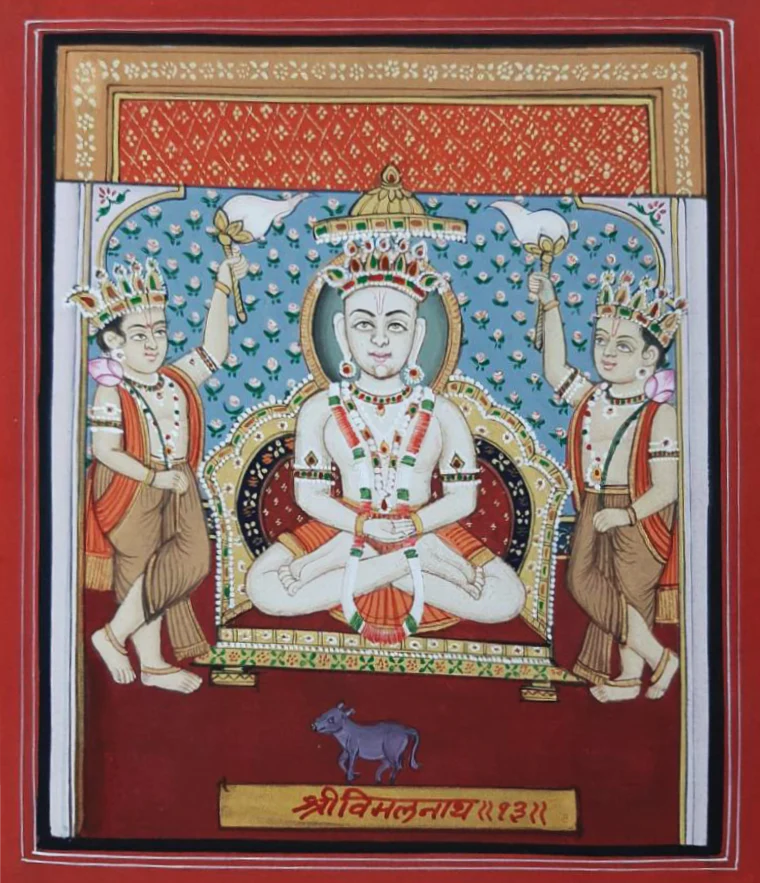
A Pichwai painting of Vimalanatha Bhagwan with the boar emblem — symbol of grounded grace
A Note for the Modern Devotee

Ancient teachings, quietly contemporary.

The wisdom of Vimalanatha is not bound to a distant century. In an age of restless attention, of cluttered hours and endless wanting, his counsel is almost unbearably gentle: do less, perceive more. Want less, become more.

Each principle is a small daily practice — a way to make of one’s life a quiet temple. Speak less, listen more. Hold things lightly. Let kindness be a discipline. Reverence every soul, including one’s own. From such soft consistencies, the inner light is gathered.

These teachings ask nothing extraordinary, only attentiveness. And attentiveness, faithfully kept, is itself the path of the Tirthankara.

— A teaching to live, not merely to read.
Continue the Pilgrimage

From philosophy to heritage and art.

Behold the temples, manuscripts, and sacred symbols through which his teachings have been carried into our own time.